Today's Dental
  • About Us
    • About Us
    • Our Dentists
    • Centralized Support Services
    • Proven Process
    • Culture
    • Join Our Team
    • Blog
  • Locations
    • Aksarben
    • Bellevue
    • Elkhorn
    • Fremont
    • Millard
    • Tranquility Park
  • Services
    • Family Dentistry
      • Preventive Care Services
      • Periodontal Care
      • Restorative Care Services
        • Tooth Extraction
      • Sedation Dentistry
      • Dental Visit Anxiety
      • Paying for Dental Care
    • Pediatric Dental Care
      • Childs First Visit
      • Preventative Care for Children
      • Comfortable Environment
    • Cosmetic Dentistry and Orthodontics
      • Teeth Whitening
      • Dental Crowns & Bridges
      • Veneers
      • Invisalign®
      • Dentures & Dental Implants
    • Urgent & Emergency Care
      • Dental Emergency
      • Urgent Care Services
      • Text-a-Dentist
  • Dental Issues
    • Bad Breath/Halitosis
    • Cavities
    • Chipped and Broken Tooth Treatment
    • Dark Teeth
    • Dental Anxiety
    • Gum Disease
    • Malocclusion
    • Root Canal
    • Soft Teeth
    • Tooth Infection
    • Tooth Pain
    • Wisdom Teeth
  • Patient Resources
    • Smile Care Plan
    • Financing
    • Insurance Checker
    • Patient Forms
    • Post Operative Instructions
  • Patient Reviews
  • Contact
  • Pay Online
  • Schedule Your Appointment
  • Menu Menu
A Steaming Cup Of Tea And A Glass Of Cold Water On A Table, Illustrating Safe Drink Choices After Tooth Extraction

Best Drinks for Recovery: What Can You Drink After Tooth Extraction

Best Drinks For Recovery

Best Drinks for Recovery: What Can You Drink After Tooth Extraction

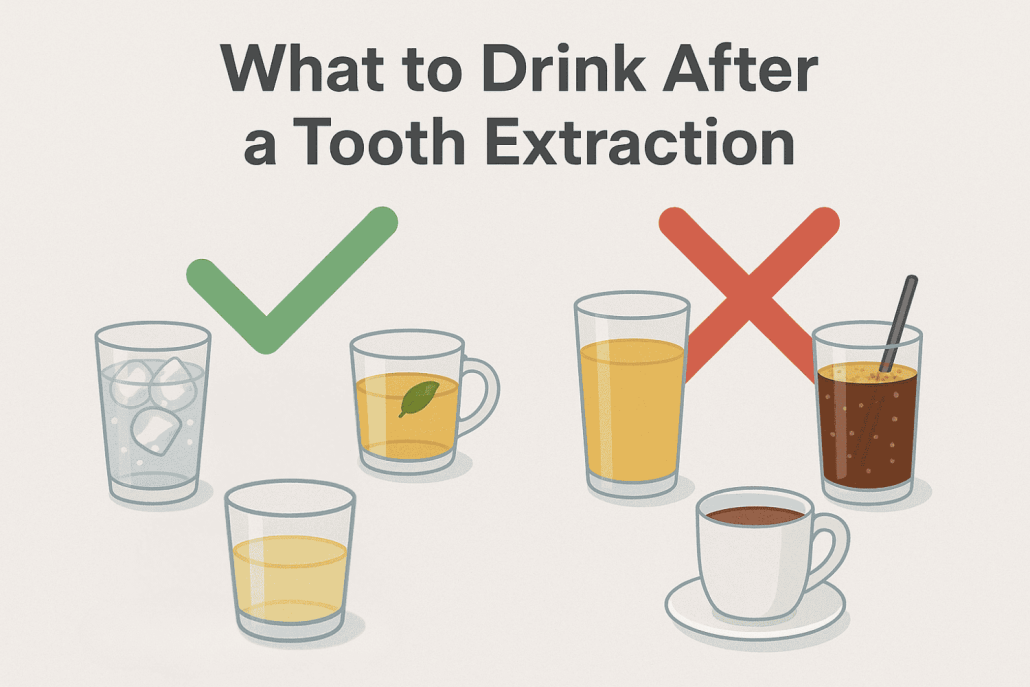
Wondering what you can drink after tooth extraction to ensure a smooth recovery? Stick to water, herbal teas, and clear broths. In this article, we will explore what can you drink after tooth extraction, covering the best beverage choices to help you heal quickly and comfortably.

Key Takeaways

  • Post-extraction hydration is essential; aim for 8-10 glasses of water daily and choose room temperature drinks to avoid irritation.
  • Avoid hot and carbonated beverages to prevent irritation and complications like dry sockets, and opt for cool or cold drinks for comfort.
  • Non-sugary and alcohol-free drinks support healing and maintain oral health; prioritize options like herbal teas, diluted fruit juices, and coconut water.

Immediate Post-Extraction Hydration

A Person Holding An Ice Bag To Their Jaw After Tooth Extraction To Reduce Swelling.

Staying hydrated after a tooth extraction is paramount to your recovery. Hydration helps flush out toxins and reduces inflammation, creating an optimal environment for healing. It’s essential to drink plenty of water to support saliva production, which protects against tooth decay and keeps your mouth moist, preventing dry sockets and promoting a healthy tooth socket.

Aim to consume at least 8-10 glasses of water daily following your extraction. Safe beverages to consume include water, clear broths, and oral rehydration solutions or coconut water, which provide additional electrolytes beneficial for recovery. In the first day post-extraction, stick to room temperature drinks to avoid irritating the extraction site.

Staying well-hydrated supports your body’s natural healing processes and reduces the risk of complications. The more you hydrate, the smoother your recovery will be.

Avoiding Hot Beverages After Extraction

A Steaming Cup Of Tea And A Glass Of Cold Water On A Table, Illustrating Safe Drink Choices After Tooth Extraction
Avoid hot beverages for at least 24 to 48 hours after wisdom tooth extraction. Hot liquids may irritate inflamed gum tissue. This irritation can slow down the healing process. Consuming hot drinks like tea or coffee can aggravate the extraction site, potentially leading to increased pain and prolonged recovery.

Instead, opt for cooler alternatives such as room temperature or cold drinks. These can help soothe the extraction area without causing further irritation. Steering clear of hot beverages enables your gums to heal more effectively.

Cold Drinks for Soothing Relief

A Selection Of Cold Drinks Including Soda And Iced Tea, Ideal For Soothing Relief After Tooth Extraction

Cold drinks can be a lifesaver after a tooth extraction. Chilled beverages provide comfort and decrease swelling. Incorporating cold drinks into your recovery routine can help maintain hydration while promoting healing.

Herbal teas served cold offer hydration along with potential anti-inflammatory benefits. Diluted fruit juices, when chilled, can provide nutritional benefits while being gentle on your mouth. These options not only help reduce inflammation but also ensure you stay hydrated and comfortable during the healing process.

The key is to drink plenty of cold, non-carbonated beverages to ensure a smooth recovery and reduce discomfort on a soft diet.

Why You Should Skip Carbonated Beverages

Avoiding carbonated beverages is critical after a tooth extraction. Carbonated drinks can irritate the surgical site and disturb the stability of blood clots, which are vital for healing. Consuming sodas or other fizzy drinks can lead to complications, prolonging the recovery process and increasing discomfort.

For a better recovery, opt for non-carbonated beverages. Options such as water, herbal teas, and diluted fruit juices are recommended. These alternatives are gentle on the extraction site and support overall healing.

The Role of Non-Sugary Drinks

Non-sugary drinks play a significant role in your recovery after a tooth extraction. High sugar content in beverages can promote bacterial growth, increasing the risk of infection during the healing process. Opting for non-sugary drinks like herbal teas, coconut water, and probiotic drinks helps maintain dental health and prevents cavities.

Coconut water is particularly beneficial as it hydrates and contains electrolytes, aiding in recovery post-extraction. Probiotic drinks like kefir can promote a healthy balance of bacteria in the mouth, further supporting oral health.

Choosing non-sugary beverages creates a healthier environment in your mouth, facilitating quicker healing and reducing the risk of complications in most cases. Soda can be a tempting option, but opting for healthier choices is beneficial.

Alcohol and Tooth Extraction: A Risky Combination

Consuming alcohol after a tooth extraction can be detrimental to your recovery. Alcohol impedes the healing process by preventing the formation of a blood clot, which is essential for recovery. Drinking alcohol increases the risk of developing a painful condition called dry socket and can interfere with pain relief medications.

Refrain from alcohol consumption until your extraction site has fully healed to avoid these risks related to surgery. Doing so will help ensure a smoother recovery and prevent unnecessary complications.

Safe Ways to Drink Without Using a Straw

Using a straw after a tooth extraction can be risky. The suction created by using a straw can dislodge blood clots, leading to dry socket and delaying healing. The sucking motion involved in using a straw can disturb the extraction site. Sip beverages directly from a cup or glass to avoid this issue.

Even when drinking iced tea or other cold beverages, avoid drinking using a straw to prevent complications. Following these tips allows you to enjoy your favorite drinks safely and support your recovery process.

Foods and Drinks to Support Healing

A Plate Of Soft Foods And A Glass Of Milk, Supporting Healing After Tooth Extraction
Choosing the right foods and drinks supports your healing process. Initially, consuming soft foods can help avoid irritation to the extraction site. Smoothies, creamy foods like pudding and oatmeal, and diluted fruit juices are excellent options that provide essential nutrients while being gentle on your healing tissues.

Gradually reintroduce solid foods into your diet as your comfort level increases. Start with easy-to-chew options to minimize discomfort. This gradual approach will support a smooth recovery and allow your mouth to heal properly.

Long-Term Beverage Choices for Oral Health

Maintaining healthy beverage choices is crucial for long-term oral health, especially after recovering from a tooth extraction. Opt for tooth-friendly drinks like water, green tea, iced coffee, and iced tea, which promote hydration, reduce inflammation, and provide antioxidants. It’s also wise to consider what to drink after tooth extraction to ensure optimal recovery.

Incorporating these beverages into your daily routine can bolster your oral health and aid in overall wellness.

Managing Discomfort and Swelling

Managing discomfort and swelling is a key part of the recovery process. Staying well-hydrated aids in the healing process and helps flush out toxins. Non-sugary beverages, such as herbal teas, can help maintain hydration without increasing the risk of infection.

Applying cold compresses to the affected area can significantly reduce swelling and pain in the first 24 hours after extraction. Herbal teas with anti-inflammatory properties, like chamomile, can also help soothe discomfort and inflammation, making your recovery more manageable.

When to Resume Normal Eating and Drinking

Knowing when to resume normal eating and drinking ensures a smooth recovery. Solid foods, crunchy foods, hard foods, and sticky foods should be avoided immediately after a tooth extraction. Gradually reintroduce solid foods into your diet about a week after the procedure, listening to your body and transitioning only when comfortable.

Typically, normal eating and drinking can resume about two weeks post-extraction. It’s also advisable to wait 7-10 days before consuming any alcoholic beverages to prevent complications and ensure proper healing during the recovery period.

Contact Today’s Dental for Expert Care

Today’s Dental has been serving the community since 1980, providing top-notch dental care with a focus on patient well-being and education. Our team of dentist professionals is dedicated to ensuring your recovery is as smooth and comfortable as possible. Visit Today’s Dental for a rewarding dental experience.

If you have questions about your recovery or need to schedule an appointment, please call your local office or use the contact form on our website. We’ll respond promptly and are committed to supporting you with transparent care and patient education every step of the way.

Summary

In summary, the choices you make about what to drink after a tooth extraction can significantly impact your recovery. Staying hydrated with non-carbonated, non-sugary beverages, avoiding hot and carbonated drinks, and steering clear of alcohol are all crucial steps. Incorporating cold beverages can help manage discomfort and swelling, while gradually reintroducing solid foods supports your healing process.

Remember, your oral health is a long-term commitment. Making mindful beverage choices now will benefit you for years to come. For personalized care and expert advice, don’t hesitate to reach out to Today’s Dental. Your recovery and well-being are our top priorities.

Frequently Asked Questions

What are the best drinks to consume immediately after a tooth extraction?

The best drinks to consume immediately after a tooth extraction are water, clear broths, and oral rehydration solutions, ideally at room temperature to minimize irritation to the extraction site.

Why should I avoid using a straw after a tooth extraction?

Avoiding a straw after a tooth extraction is crucial, as the suction can dislodge blood clots, potentially causing dry socket and prolonging your recovery.

How long should I avoid hot beverages after a tooth extraction?

You should avoid hot beverages for at least 24 to 48 hours after a tooth extraction to minimize irritation and support the healing process.

What role do non-sugary drinks play in recovery after a tooth extraction?

Non-sugary drinks play a crucial role in recovery after a tooth extraction by preventing bacterial growth and infections, which supports oral health and aids in a smoother healing process. It’s essential to prioritize these beverages during your recovery.

When can I resume eating solid foods after a tooth extraction?

You can typically resume eating solid foods about a week after your tooth extraction, but be sure to gauge your comfort and healing progress before doing so.

Embrace Your Smile: Expert Care for Tooth Extraction at Today’s Dental

Contact Us

Frequently Asked Questions (FAQ’s)

What are the best drinks to consume immediately after a tooth extraction?

The best drinks to consume immediately after a tooth extraction are water, clear broths, and oral rehydration solutions, ideally at room temperature to minimize irritation to the extraction site.

Why should I avoid using a straw after a tooth extraction?

Avoiding a straw after a tooth extraction is crucial, as the suction can dislodge blood clots, potentially causing dry socket and prolonging your recovery.

How long should I avoid hot beverages after a tooth extraction?

You should avoid hot beverages for at least 24 to 48 hours after a tooth extraction to minimize irritation and support the healing process.

What role do non-sugary drinks play in recovery after a tooth extraction?

Non-sugary drinks play a crucial role in recovery after a tooth extraction by preventing bacterial growth and infections, which supports oral health and aids in a smoother healing process. It’s essential to prioritize these beverages during your recovery.

When can I resume eating solid foods after a tooth extraction?

You can typically resume eating solid foods about a week after your tooth extraction, but be sure to gauge your comfort and healing progress before doing so.

Ready for Your Next Visit?

Schedule your dental appointment today and take the first step toward a healthier smile.

Schedule an Appointment

or call us at (402) 333-6288

Today'S Dental Logo

Today’s Dental began in 1980 with one location. It was founded with the goal of providing high-quality, safe, convenient, and comfortable dental care in a family-friendly setting.

Related Services

  • Services

Our Locations

  • Aksarben2141 S. 63rd Street, Omaha
  • Bellevue2207 Longo Drive, Bellevue
  • Millard14406 Harrison St., Omaha
  • Tranquility12322 Emmet St., Omaha
  • Elkhorn20211 Manderson St., Elkhorn
  • Fremont1689 E 23 Street, Fremont

Today’s Dental

We’re committed to working with you and your family to create a comfortable, stress-free, and exceptionally rewarding dental care experience.

Locations

  • Millard
  • Tranquility Park
  • Elkhorn
  • Aksarben
  • Bellevue
  • Fremont

Patient Resources

  • Smile Care Plan
  • Financing
  • Patient Forms
  • Reviews
  • Open Accessibility
  • Privacy Policy

Blog

Pay Online

Join Our Team

Today’s Dental

We’re committed to working with you and your family to create a comfortable, stress-free, and exceptionally rewarding dental care experience.

Locations

  • Millard
  • Tranquility Park
  • Elkhorn
  • Aksarben
  • Bellevue
  • Fremont

Patient Resources

  • Smile Care Plan
  • Financing
  • Patient Forms
  • Reviews
  • Open Accessibility
  • Privacy Policy

Blog

Pay Online

Join Our Team

© Copyright 2026 – Omaha Dentistry | Website design and SEO provided by Robben Media

Link to: Optimal Sedation for Wisdom Teeth Extraction Your Guide to a Smooth Procedure Link to: Optimal Sedation for Wisdom Teeth Extraction Your Guide to a Smooth Procedure Optimal Sedation for Wisdom Teeth Extraction Your Guide to a Smooth Procedu...Wisdom Teeth ExtractionLink to: How to Manage Stress and Bleeding Gums Effectively Link to: How to Manage Stress and Bleeding Gums Effectively Manage Stress And Bleeding GumsHow to Manage Stress and Bleeding Gums Effectively
Scroll to top Scroll to top Scroll to top
Translate »
Accessibility
Accessibility modes
Epilepsy Safe Mode
Dampens color and removes blinks
This mode enables people with epilepsy to use the website safely by eliminating the risk of seizures that result from flashing or blinking animations and risky color combinations.
Visually Impaired Mode
Improves website's visuals
This mode adjusts the website for the convenience of users with visual impairments such as Degrading Eyesight, Tunnel Vision, Cataract, Glaucoma, and others.
Cognitive Disability Mode
Helps to focus on specific content
This mode provides different assistive options to help users with cognitive impairments such as Dyslexia, Autism, CVA, and others, to focus on the essential elements of the website more easily.
ADHD Friendly Mode
Reduces distractions and improve focus
This mode helps users with ADHD and Neurodevelopmental disorders to read, browse, and focus on the main website elements more easily while significantly reducing distractions.
Blindness Mode
Allows using the site with your screen-reader
This mode configures the website to be compatible with screen-readers such as JAWS, NVDA, VoiceOver, and TalkBack. A screen-reader is software for blind users that is installed on a computer and smartphone, and websites must be compatible with it.
Online Dictionary
    Readable Experience
    Content Scaling
    Default
    Text Magnifier
    Readable Font
    Dyslexia Friendly
    Highlight Titles
    Highlight Links
    Font Sizing
    Default
    Line Height
    Default
    Letter Spacing
    Default
    Left Aligned
    Center Aligned
    Right Aligned
    Visually Pleasing Experience
    Dark Contrast
    Light Contrast
    Monochrome
    High Contrast
    High Saturation
    Low Saturation
    Adjust Text Colors
    Adjust Title Colors
    Adjust Background Colors
    Easy Orientation
    Mute Sounds
    Hide Images
    Hide Emoji
    Reading Guide
    Stop Animations
    Reading Mask
    Highlight Hover
    Highlight Focus
    Big Dark Cursor
    Big Light Cursor
    Cognitive Reading
    Virtual Keyboard
    Navigation Keys
    Voice Navigation

    Today's Dental

    Accessibility Statement

    • omahadentists.net
    • June 10, 2026

    Compliance status

    We firmly believe that the internet should be available and accessible to anyone, and are committed to providing a website that is accessible to the widest possible audience, regardless of circumstance and ability.

    To fulfill this, we aim to adhere as strictly as possible to the World Wide Web Consortium’s (W3C) Web Content Accessibility Guidelines 2.1 (WCAG 2.1) at the AA level. These guidelines explain how to make web content accessible to people with a wide array of disabilities. Complying with those guidelines helps us ensure that the website is accessible to all people: blind people, people with motor impairments, visual impairment, cognitive disabilities, and more.

    This website utilizes various technologies that are meant to make it as accessible as possible at all times. We utilize an accessibility interface that allows persons with specific disabilities to adjust the website’s UI (user interface) and design it to their personal needs.

    Additionally, the website utilizes an AI-based application that runs in the background and optimizes its accessibility level constantly. This application remediates the website’s HTML, adapts Its functionality and behavior for screen-readers used by the blind users, and for keyboard functions used by individuals with motor impairments.

    If you’ve found a malfunction or have ideas for improvement, we’ll be happy to hear from you. You can reach out to the website’s operators by using the following email

    Screen-reader and keyboard navigation

    Our website implements the ARIA attributes (Accessible Rich Internet Applications) technique, alongside various different behavioral changes, to ensure blind users visiting with screen-readers are able to read, comprehend, and enjoy the website’s functions. As soon as a user with a screen-reader enters your site, they immediately receive a prompt to enter the Screen-Reader Profile so they can browse and operate your site effectively. Here’s how our website covers some of the most important screen-reader requirements, alongside console screenshots of code examples:

    1. Screen-reader optimization: we run a background process that learns the website’s components from top to bottom, to ensure ongoing compliance even when updating the website. In this process, we provide screen-readers with meaningful data using the ARIA set of attributes. For example, we provide accurate form labels; descriptions for actionable icons (social media icons, search icons, cart icons, etc.); validation guidance for form inputs; element roles such as buttons, menus, modal dialogues (popups), and others. Additionally, the background process scans all the website’s images and provides an accurate and meaningful image-object-recognition-based description as an ALT (alternate text) tag for images that are not described. It will also extract texts that are embedded within the image, using an OCR (optical character recognition) technology. To turn on screen-reader adjustments at any time, users need only to press the Alt+1 keyboard combination. Screen-reader users also get automatic announcements to turn the Screen-reader mode on as soon as they enter the website.

      These adjustments are compatible with all popular screen readers, including JAWS and NVDA.

    2. Keyboard navigation optimization: The background process also adjusts the website’s HTML, and adds various behaviors using JavaScript code to make the website operable by the keyboard. This includes the ability to navigate the website using the Tab and Shift+Tab keys, operate dropdowns with the arrow keys, close them with Esc, trigger buttons and links using the Enter key, navigate between radio and checkbox elements using the arrow keys, and fill them in with the Spacebar or Enter key.Additionally, keyboard users will find quick-navigation and content-skip menus, available at any time by clicking Alt+1, or as the first elements of the site while navigating with the keyboard. The background process also handles triggered popups by moving the keyboard focus towards them as soon as they appear, and not allow the focus drift outside it.

      Users can also use shortcuts such as “M” (menus), “H” (headings), “F” (forms), “B” (buttons), and “G” (graphics) to jump to specific elements.

    Disability profiles supported in our website

    • Epilepsy Safe Mode: this profile enables people with epilepsy to use the website safely by eliminating the risk of seizures that result from flashing or blinking animations and risky color combinations.
    • Visually Impaired Mode: this mode adjusts the website for the convenience of users with visual impairments such as Degrading Eyesight, Tunnel Vision, Cataract, Glaucoma, and others.
    • Cognitive Disability Mode: this mode provides different assistive options to help users with cognitive impairments such as Dyslexia, Autism, CVA, and others, to focus on the essential elements of the website more easily.
    • ADHD Friendly Mode: this mode helps users with ADHD and Neurodevelopmental disorders to read, browse, and focus on the main website elements more easily while significantly reducing distractions.
    • Blindness Mode: this mode configures the website to be compatible with screen-readers such as JAWS, NVDA, VoiceOver, and TalkBack. A screen-reader is software for blind users that is installed on a computer and smartphone, and websites must be compatible with it.
    • Keyboard Navigation Profile (Motor-Impaired): this profile enables motor-impaired persons to operate the website using the keyboard Tab, Shift+Tab, and the Enter keys. Users can also use shortcuts such as “M” (menus), “H” (headings), “F” (forms), “B” (buttons), and “G” (graphics) to jump to specific elements.

    Additional UI, design, and readability adjustments

    1. Font adjustments – users, can increase and decrease its size, change its family (type), adjust the spacing, alignment, line height, and more.
    2. Color adjustments – users can select various color contrast profiles such as light, dark, inverted, and monochrome. Additionally, users can swap color schemes of titles, texts, and backgrounds, with over seven different coloring options.
    3. Animations – person with epilepsy can stop all running animations with the click of a button. Animations controlled by the interface include videos, GIFs, and CSS flashing transitions.
    4. Content highlighting – users can choose to emphasize important elements such as links and titles. They can also choose to highlight focused or hovered elements only.
    5. Audio muting – users with hearing devices may experience headaches or other issues due to automatic audio playing. This option lets users mute the entire website instantly.
    6. Cognitive disorders – we utilize a search engine that is linked to Wikipedia and Wiktionary, allowing people with cognitive disorders to decipher meanings of phrases, initials, slang, and others.
    7. Additional functions – we provide users the option to change cursor color and size, use a printing mode, enable a virtual keyboard, and many other functions.

    Browser and assistive technology compatibility

    We aim to support the widest array of browsers and assistive technologies as possible, so our users can choose the best fitting tools for them, with as few limitations as possible. Therefore, we have worked very hard to be able to support all major systems that comprise over 95% of the user market share including Google Chrome, Mozilla Firefox, Apple Safari, Opera and Microsoft Edge, JAWS and NVDA (screen readers).

    Notes, comments, and feedback

    Despite our very best efforts to allow anybody to adjust the website to their needs. There may still be pages or sections that are not fully accessible, are in the process of becoming accessible, or are lacking an adequate technological solution to make them accessible. Still, we are continually improving our accessibility, adding, updating and improving its options and features, and developing and adopting new technologies. All this is meant to reach the optimal level of accessibility, following technological advancements. For any assistance, please reach out to