
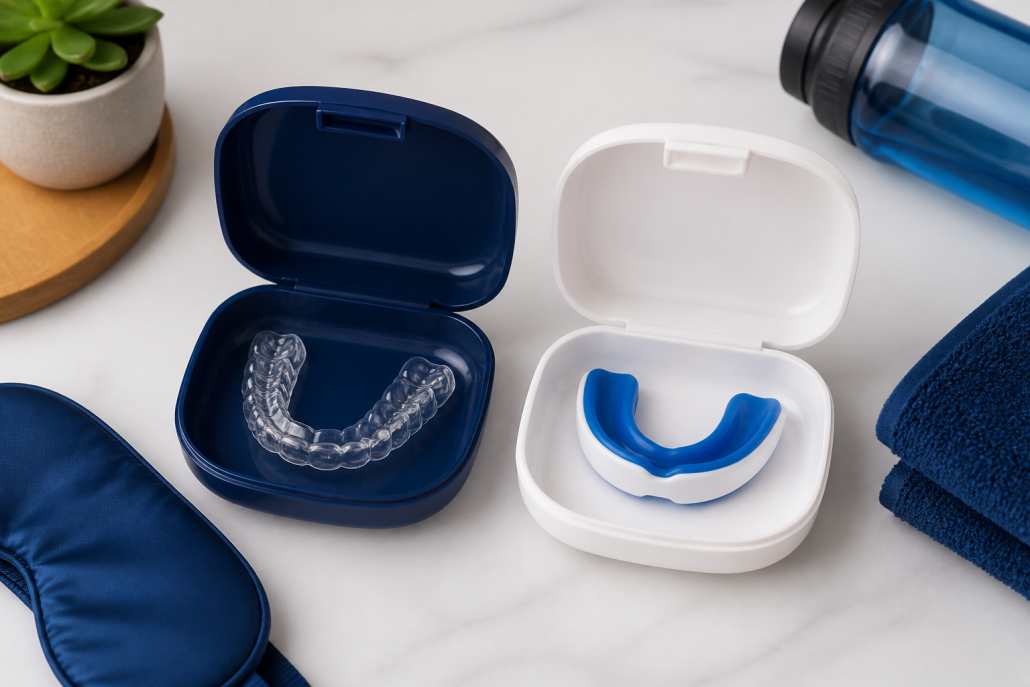
Night Guards vs. Sports Mouthguards: Why They Are Not Interchangeable
Night Guards vs. Sports Mouthguards: Why They Are Not Interchangeable
A night guard and a sports mouthguard can both sit over the teeth, but they are designed for different situations. A night guard is generally discussed for nighttime grinding or clenching. An athletic mouthguard is designed to protect the mouth during sports and physical activity.
Using the wrong appliance can create a poor fit for the task and a false sense of protection. The choice should begin with why the appliance is needed, when it will be worn, and what a dentist observes in the person’s mouth.
What a night guard is for
A night guard may be recommended to place a barrier between the teeth and manage effects associated with grinding or clenching during sleep. Design, material, and coverage can vary based on the patient and the dentist’s goals.
Today’s Dental lists mouthguards for teeth grinding within its preventive care services. That service-page statement does not establish which appliance is appropriate for an individual or which offices currently provide it.
A night guard is not automatically a treatment for every jaw, tooth, sleep, or headache concern. Symptoms need professional evaluation rather than self-diagnosis from worn enamel or morning discomfort alone.
What a sports mouthguard is for
An athletic mouthguard is worn during activities where contact, falls, equipment, or fast movement can injure the teeth and soft tissues. It is designed with retention, coverage, breathing, speaking, and impact protection in mind.
The American Dental Association provides an overview of athletic mouth protectors. The American Academy of Pediatric Dentistry also publishes professional guidance on the prevention of sports-related orofacial injuries.
No mouthguard can promise to prevent every dental injury or concussion. Product marketing should not replace a dentist’s fit assessment or the safety requirements of the sport.
Why a night guard should not be used as a sports guard
An appliance made for sleeping may not have the impact-absorbing design, coverage, or retention expected for athletic use. It may also shift, interfere with communication, or be damaged during contact.
The fact that it feels thicker or more rigid does not prove it is protective for a sport. Ask a dentist what the appliance was designed to do and follow the instructions for that exact product.
Why a sports guard should not become a nightly grinding guard
A sports mouthguard is intended for limited use during activity. Wearing one night after night changes the wear environment and may create fit, hygiene, durability, or bite concerns that it was not designed to manage.
If a person grinds their teeth and plays sports, they may need separate conversations—and potentially separate appliances—for each use. Do not assume one guard can safely cover both jobs.
Stock, boil-and-bite, and custom sports guards
Sports mouthguards are commonly grouped into stock, mouth-formed or boil-and-bite, and custom-fabricated options. Fit, retention, comfort, and cost can differ within each group.
A low price does not help if the guard is not worn, and a custom label does not guarantee protection from every injury. Ask what level of activity, age, dental development, braces, and prior injuries mean for the choice.
This draft does not claim that Today’s Dental fabricates athletic guards. Exact availability should be confirmed with the practice.
Fit matters for both appliances
An appliance should stay where it belongs without requiring constant biting or adjustment. It also should not create an unexplained pressure point, sore area, or bite concern.
Fit can change as children grow, teeth erupt, orthodontic treatment progresses, or dental work changes tooth shape. An appliance that once fit should not be assumed to fit indefinitely.
What if the athlete has braces?
Braces require special consideration because teeth may be moving and brackets can contact the lips or cheeks. Ask the orthodontist and dentist which type of guard is appropriate, how much room is needed for movement, and how often fit should be rechecked.
Do not trim or alter an appliance around braces without professional guidance. The sport’s rules and the orthodontic treatment plan may both affect the recommendation.
When should a mouthguard be replaced?
Replacement timing depends on growth, tooth movement, wear, tears, distortion, changes in dental work, and the manufacturer’s or dentist’s instructions. Children and teens may need more frequent fit checks because their mouths are changing.
Inspect the guard regularly and bring it to dental visits when asked. A guard that is cracked, loose, difficult to clean, or uncomfortable deserves attention even if it has not reached a suggested age.
How should a guard be cleaned and stored?
Follow the instructions for the exact material. In general, ask the dental team how to rinse, brush, dry, and store the appliance without warping or damaging it.
A ventilated protective case may help between uses, but the case needs cleaning too. Avoid exposing the appliance to heat unless the product instructions specifically call for a fitting step supervised as directed.
Questions to ask a dentist about grinding
•What signs suggest grinding or clenching should be evaluated?
•Is a night guard appropriate, or could another condition be contributing?
•What material and coverage are planned, and why?
•How will the bite and fit be checked?
•What changes should prompt a follow-up?
•How should the guard be cleaned and stored?
These questions help define the purpose of the appliance without assuming a diagnosis or outcome.
Questions to ask about sports protection
•Which sports or activities make a mouthguard especially important?
•What type offers an appropriate balance of fit, retention, and protection for this athlete?
•How do braces, missing teeth, erupting teeth, or recent dental work affect the choice?
•Does the sport, league, school, or governing body have equipment requirements?
•How often should the fit be checked?
•What should we do after a blow to the mouth or a damaged guard?
Contact a dental professional promptly after a dental injury. A mouthguard does not eliminate the need for evaluation when a tooth, jaw, or soft tissue may be hurt.
Discussing the appropriate guard for you is a conversation that can be had at your scheduled dental check up or can be a separate appointment. Our main goal at Today’s Dental is to work with you on the best treatment possible under all circumstances.
Two jobs usually call for two decisions
Night guards and sports mouthguards should not be treated as interchangeable just because both cover teeth. One conversation addresses sleep-related grinding or clenching; the other addresses protection during activity.
Today’s Dental can evaluate preventive-care questions through its family preventive care and pediatric preventive care information. To ask about an individual need and exact office availability, request an appointment.

